News & Insights
MENU


November 26, 2026
Thirteen years of anticipation, a remarkably short marketing campaign and millions of pre-orders. GTA VI is a masterclass in building hype, but its most valuable communications lessons are beyond the headlines.

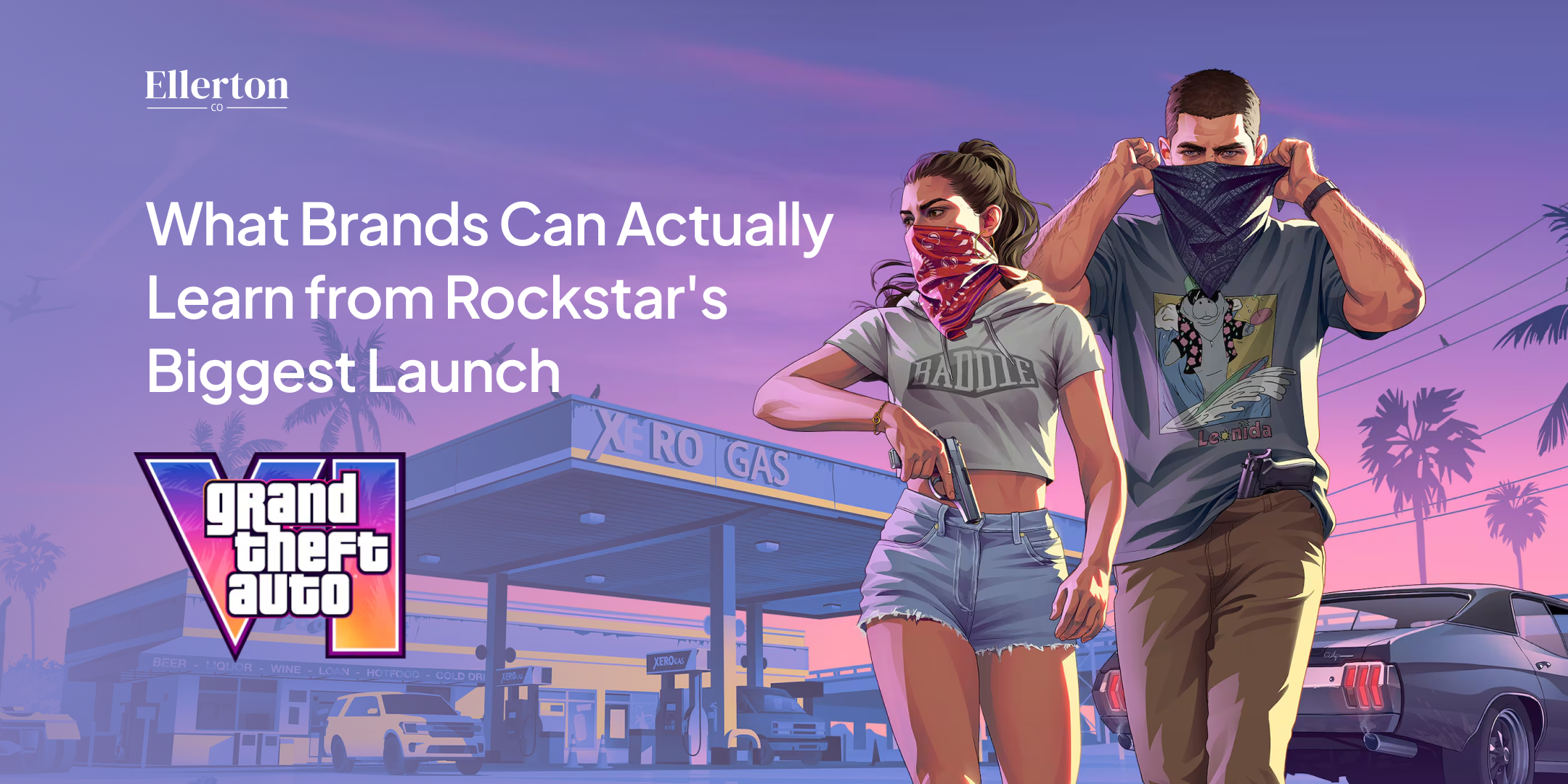
Most brands spend months fighting for attention. Rockstar Games spent years saying almost nothing, and yet the world listened keenly.
The launch of Grand Theft Auto VI (GTA VI) is one of the biggest entertainment events of the decade. Thirteen years after its predecessor, the game arrived with extraordinary expectations, a fiercely loyal fanbase and a level of anticipation that most marketing teams could only dream of generating.
This isn’t a post about the game, there’s plenty of them already. We want to dive into what communications professionals can learn and put into practice without requiring a budget in the tens of millions.
Rockstar can afford to break the rules because it has spent decades earning the right to.
For most brands, going quiet for months would mean losing relevance, not creating anticipation. And while GTA VI's trailers, carefully timed announcements and high-profile partnerships attracted enormous attention, those aren't necessarily the most useful lessons.
The more interesting story is how Rockstar navigated leaks, delays, difficult commercial decisions and public scrutiny. More importantly, what happened when its famously restrained communications strategy stopped working.
At Ellerton & Co., we examined Meltwater news coverage worldwide, in India and across six Southeast Asian markets to understand how the narrative shifted during these moments.
The findings offer a more practical perspective on what brands can learn from one of entertainment's most anticipated launches.
Not Just a Video Game
My own introduction to Grand Theft Auto was back in 2007 on the PlayStation 2, exploring Liberty City. What fascinated me wasn't simply the gameplay, but the freedom to explore an entire virtual world, alongside the depth and personality of its characters.
Admittedly, I haven't played every instalment since, but I have continued to follow the franchise. It’s almost impossible not to. Beyond its commercial success, I've always regarded it as a technical and cultural achievement.
For those unfamiliar with the series, Grand Theft Auto is an open-world video game franchise developed by Rockstar Games, a subsidiary of Nasdaq-listed Take-Two Interactive. Players explore fictional American cities inspired by real locations, with stories combining crime, satire, and social commentary.
The franchise has sold nearly 480 million copies worldwide. Its predecessor, GTA V, released in September 2013, generated approximately US$1 billion in its first three days alone. To date, it has sold nearly 235 million copies.
The newest release, GTA VI, returns to Vice City, a location heavily inspired by Miami, with two protagonists, Jason and Lucia. Its launch marks the first new main instalment in thirteen years.
That kind of anticipation is difficult to manufacture as it builds upon years of continued success amongst a fanbase that has grown alongside it. It is also precisely why the campaign deserves closer attention from anyone working in communications.
Consider how Rockstar built excitement for GTA VI.
The first official trailer arrived in December 2023, attracting more than 90 million YouTube views in 24 hours. The second followed in May 2025 and generated more than 475 million views across platforms in its first day, according to figures reported by The Hollywood Reporter.
Between major announcements, Rockstar offered remarkably little information.
There was no constant stream of executive interviews. No weekly content calendar designed to maintain engagement. No desperate attempt to fill every silence.
Instead, fans did much of the work themselves. They analysed screenshots, developed theories, created memes, and kept the conversation alive using those highly impactful trailer videos.
The main advertising campaign lasted approximately five months, and it was supported by major partnerships, music releases, magazine coverage and a highly visible promotional presence in Miami.
The world got a clearer vision of the upcoming title when a 27-minute GTA VI gameplay presentation premiered on Netflix in August 2026. That attracted a reported 31.1 million views in four days.
For a company with Rockstar's cultural influence, scarcity became a core part of the attraction.
But imagine a fintech company in Jakarta or an enterprise software provider in Ho Chi Minh City adopting the same strategy.
Disappear for a year, offer little explanation and assume customers will eagerly await your return.
Chances are, they won't.
Scarcity only creates demand when people already want what you're withholding.
Rockstar's approach succeeded because it was built on thirteen years of anticipation and decades of brand equity. Most businesses operate in competitive markets where consistent communication is necessary to remain relevant.
The real question, then, isn't how to recreate Rockstar's marketing campaign. It's what we can learn from the moments when its strategy was put under pressure.
One of the less celebrated aspects of Rockstar's communications strategy was the clear distinction between who spoke about the product and who addressed the business.
Rockstar rarely gave interviews. Its public statements were brief, deliberate and largely focused on the game itself.
It was Take-Two Interactive, the parent company, that handled the commercial questions.
As a publicly listed company, Take-Two regularly engaged investors and journalists through quarterly earnings calls. Its CEO, Strauss Zelnick, became the public voice addressing sensitive issues including GTA VI's US$79.99 price tag, the lack of a PC version at launch, the use of generative AI and repeated release delays.
When the game's pricing attracted criticism, Zelnick defended it as "an incredible bargain".
Whether audiences agreed is another matter. What stood out was how the two organisations maintained distinct communications roles.
Rockstar protected its identity as the creative studio delivering the experience. Take-Two addressed the financial and commercial realities behind it.
For brands, this is a surprisingly overlooked discipline.
Too often, companies expect one spokesperson to handle everything, from product innovation and brand storytelling to pricing disputes, operational problems and corporate controversies.
The result? A spokesperson meant to inspire confidence in the product can become associated primarily with defending difficult business decisions or covering topics outside of their expertise.
Not every spokesperson needs to answer every question.
Clear responsibilities, agreed before an issue arises, help companies communicate more consistently while ensuring difficult questions reach the people best placed to answer them.
With GTA VI one of the most hyped games ever, Rockstar has had more than its fair share of leaks.
In September 2022, a hacker accessed its systems and released approximately 90 clips of unfinished GTA VI footage. The first official trailer was also leaked online hours before its scheduled December 2023 debut.
Rather than engage in a prolonged public argument, Rockstar brought forward the official trailer and directed audiences towards the real release.
A more complicated situation emerged in August 2026, however.
By then, pre-orders had been open for two months, but fans had yet to see an extended official gameplay demonstration. Nine days before a highly anticipated Netflix premiere, an anonymous group began publishing unreleased footage alongside a list of demands.
Rockstar did not immediately respond publicly.
Take-Two pursued legal action to identify the source of the leaks, while Rockstar eventually issued a short statement describing the situation as "heartbreaking for our team".
It did not name the group or repeat its demands.
The planned gameplay premiere proceeded the following day.
Our Meltwater analysis revealed a striking pattern.
At its peak, the leak generated 3,878 news mentions worldwide. The day after the official gameplay premiere, coverage surged to 10,987 mentions.
Southeast Asia followed a similar trajectory. Across Singapore, Indonesia, Malaysia, Thailand, Vietnam and the Philippines, coverage rose from 122 mentions at the leak's peak to 399 following the official presentation.
The planned reveal generated almost three times as much news coverage as the leak's biggest day.
The sentiment of that coverage shifted too.
During the leak, negative news coverage outweighed positive coverage across the markets we examined. Following the official premiere, the balance reversed.
In Southeast Asia, the proportion of negative coverage fell from 18% to 9%. In India, it declined from 34% to 13%.
These figures need some context, though.
Automated sentiment analysis measures the language used in reporting, not necessarily how journalists or audiences feel about a brand. Stories about data breaches and leaks naturally contain negative terminology.
When our team manually reviewed 36 articles classified as negative in India, only one was clearly critical of Rockstar's handling of the situation. Most were negative about the leak itself.
We should also note that we can’t conclude that Rockstar's restraint alone caused the subsequent shift. A long-awaited gameplay reveal was always likely to attract substantial positive attention.
But one observation stands out: the leak did not become the defining story of the month.
Even during the leak week, Netflix appeared in 43% of English-language news coverage about the game, indicating that attention was already being directed towards the upcoming official presentation.
The lesson isn't that brands should ignore a leak and hope it disappears.
It's that crisis communications should avoid unnecessarily amplifying the very narrative a company is trying to contain.
Rockstar separated its legal response from its public communications, avoided repeating the leakers' demands and allowed its planned announcement to reclaim attention.
For organisations facing information leaks, the practical takeaway is to prepare an appropriate response, communicate verified information and make official material available as soon as it is responsible to do so.
A crisis may create the first headline, but it doesn't have to control the next one.
Some of the issues were in control of the team. When it comes to timing, GTA VI's launch was delayed not once but twice.
Originally expected in 2025, it was first pushed to May 2026 before being moved again to November 2026.
For an ordinary product, a delay is frustrating. For a franchise of this scale, the implications extend much further.
Millions of fans were disappointed. Other game publishers had to consider their own release schedules. Investors reacted, with Take-Two's share price falling around 10% following each postponement.
Yet Rockstar's initial response was remarkably straightforward.
When announcing the first delay in May 2025, the company said: "We are very sorry that this is later than you expected."
There was no elaborate explanation about evolving priorities. No attempt to disguise disappointing news as an exciting new development. Just an apology and a revised date.
The August 2026 statement addressing the gameplay leaks followed a similar approach by acknowledging the lengthy wait and apologising for the limited information shared.
This may sound obvious, but anyone who has worked in corporate communications knows how quickly a simple apology can get buried under layers of carefully approved language. Brands sometimes become so concerned with avoiding liability or reputational damage that their statements stop sounding human.
That doesn't mean every situation calls for an admission of fault. Legal, regulatory and operational considerations matter, particularly during a crisis. But where an apology is appropriate, clarity is usually more valuable than corporate language.
People don't need three paragraphs of carefully constructed reassurance when one sincere sentence will do.
There was another interesting difference between Rockstar's two release delays. The first was announced on 2 May 2025. Four days later, Rockstar unexpectedly released its second GTA VI trailer, giving fans something new to discuss and look forward to.
The second delay, announced in November 2025, came shortly after reports of employee dismissals. In this instance, no comparable major reveal followed.
The difference appeared clearly in our media analysis.
Approximately 8% of worldwide news coverage surrounding the first delay was classified as negative. For the second, that figure rose to 24%.
This doesn't prove that releasing the second trailer caused a more favourable response. A second delay is inherently more frustrating than a first, and the surrounding circumstances were different.
Still, the pattern illustrates an important communications principle.
When audiences receive disappointing news, they need more than an explanation of what went wrong. They also need a credible reason to remain confident about what comes next.
For businesses, that could mean communicating a clear recovery plan, demonstrating tangible progress or providing a realistic timeline for resolving the problem.
The crucial word is credible.
Positive announcements should never be used to distract from serious unresolved concerns. But allowing a setback to become the only story audiences hear can deepen uncertainty.
Good crisis communications acknowledge the problem while giving people a reason to believe progress is possible.
For all the attention Rockstar generated by saying very little, its approach was not without weaknesses.
Two issues demonstrate where silence becomes considerably harder to defend.
The controversy over physical copies
When pre-orders opened in June 2026, Rockstar confirmed that the boxed edition of GTA VI would contain a download code rather than a physical disc.
For some customers, that undermined the purpose of buying a physical edition. A digital code cannot be resold, lent to another player or preserved in the same way as a functioning game disc.
The decision generated significant discussion as the data shows:
During that week, pricing appeared in 59% of English-language news coverage about the game, while the disc-less edition appeared in 25%.
Despite the attention, our research found no substantive public explanation from Rockstar addressing the latter concern.
The issue resurfaced in the days before launch. Some buyers reported that their boxed copies arrived with missing or previously redeemed download codes, across both PlayStation 5 and Xbox editions and several retailers. With no disc in the box, those customers had no other way to install the game.
Some said they were refused a replacement or passed between the retailer and Rockstar support, although others have since received replacement copies.
At the time of writing, Rockstar had not publicly addressed the reports. For a brand with such a dedicated fanbase, the absence of a clear explanation risks allowing customer frustration to grow.
The employee dismissal dispute
A more serious issue emerged in October 2025, when Rockstar dismissed more than 30 employees in the UK and Canada.
The Independent Workers' Union of Great Britain alleged that the dismissals were connected to union organising. Rockstar denied this, maintaining that the employees had been dismissed for gross misconduct involving confidential information.
The dispute progressed to an employment tribunal in Glasgow, where closing submissions were heard on 17 November 2026.
At the time of writing, the tribunal has not issued a judgment and no date has been given for one. Rockstar has said it remains confident of a positive outcome.
The day the dismissals were widely reported was the most negative single day in our dataset, with 49% of worldwide news coverage classified as negative.
Interestingly, the issue generated relatively limited coverage compared with the broader GTA VI campaign. In the four weeks of 2026 news coverage we examined, it accounted for no more than 4% of English-language reporting about the game.
A communications team looking purely at share of coverage might conclude that the matter had been contained. But reputation cannot be measured by media volume alone.
The dispute persisted for more than a year, attracted parliamentary attention in the UK and continued to create uncertainty ahead of the game's launch.
The underlying allegations remain contested, and the outcome is a matter for the legal process. From a communications perspective, however, the distinction is clear.
Silence works when people are waiting for something they want. It becomes a liability when they're waiting for answers.
Fans anticipating a game might fill the silence with excitement and speculation.
Employees questioning workplace decisions, or customers experiencing problems with a product, are far less likely to respond the same way.
For brands, knowing the difference is essential.
Why Southeast Asian Brands Should Pay Attention
It would be easy to dismiss GTA VI as an exceptional case involving an exceptional brand. To some extent that is true. However, the way its stories travelled offers a relevant lesson for businesses operating across Southeast Asia.
Our Meltwater analysis showed that major developments in the GTA VI campaign were reflected in regional news coverage within approximately a day of appearing globally.
The leaks, official reveals, trailers and pre-load announcements all generated corresponding movements in Southeast Asian reporting. Indonesia alone accounted for roughly half of the six-market coverage measured.
For regional communications teams, this reinforces a familiar challenge: reputational issues rarely respect geographical boundaries.
A story that breaks in one market can quickly reach audiences in another, often through different languages, media outlets and cultural perspectives. That means communication strategies cannot operate in isolation.
A company may manage an issue effectively at headquarters, only to discover that its regional teams are unprepared to answer questions from local journalists, customers or employees.
The most important lesson from Rockstar's campaign isn't how to recreate its hype. It's how to build the communications discipline needed when circumstances become unpredictable.
For brands, four priorities stand out:
The Real Lesson Behind GTA VI's Marketing Success
Rockstar had thirteen years of anticipation and decades of brand equity working in its favour. It used those advantages to build an extraordinary launch campaign, proving that brands don't always need to communicate constantly to command attention.
But most companies don't have Rockstar's luxury. They operate in markets where attention is fleeting, competition is relentless and reputations can change quickly.
What makes the GTA VI story valuable isn't simply the scale of its success. It's the contrast between the moments when restraint strengthened Rockstar's position and those when silence left important questions unanswered.
For communications professionals, that distinction matters far more than the billboards, trailers or marketing budget.
Because knowing when to stay quiet is a skill, and knowing when to break that silence is just as important.
Ellerton & Co. advises companies across Southeast Asia and India on reputation management, crisis communications and integrated campaigns. To discuss preparing your organisation for its next high-stakes moment, contact growth@ellerton.sg
The analysis draws on Meltwater news coverage examined by Ellerton & Co.
Stay ahead with analysis and communications insights from teams working across SEA, India, and Europe.
Stay informed with Ellerton & Co.’s latest updates and expert insights at the intersection of PR and business.