News & Insights
MENU


May 4, 2026
Public relations (PR) is not rocket science, yet rocket scientists treat it like it is. Most academic research technology companies are missing PR opportunities that comparable B2B SaaS firms seized years ago.


I examined 100+ research technology (ResTech) platforms and companies to find:
Then I ran my findings by my colleague and fellow Ellerton advisor, Dr. Gareth Dyke, for his insider take from the scholarly publishing industry.
“I’d never considered that PR could be so valuable for the many ResTech companies I’m in touch with every day,” Gareth told me. “They’re missing such a massive opportunity for visibility. And so many products and services are totally unknown outside academic circles.”
Hopefully, these findings open some eyes at ambitious ResTech companies that want to attract leads, customers, funders, and capital.
PR isn't just press releases. Indeed, many folks think PR stands for “press release” rather than “public relations.” PR does indeed have press releases central in its work, but there's a lot more going on:
… all factors that influence public perception.
Most ResTech companies are underinvesting across all of these. The activity that does exist concentrates into conference keynotes and trade press, maybe some blog content.
I think three structural forces drive this.
I looked at 100+ tools from the MacroLingo AI Tool Search Tool I built to serve as a resource for AI tool-curious academics and those in their orbit.
For ResTech entities spanning market research firms, academic publishing infrastructure, and AI-native discovery tools, communications activity drops sharply as tools become more specialized for the academic workflow.
Top B2B SaaS companies publish 10 or more press releases per year – just as one indicator – while most AI-native research tools publish 0–2. Trusted scholarly vehicles like The Scholarly Kitchen, Research Information, and STM News, as well as industry conference panels, absorb most of what little academia-related PR efforts exist.
AI discovery is a good barometer of brand perception, and, simply, it’s how companies get found. Earned media placements are 5.3 times more likely to be the sole source of a brand's AI visibility than the brand’s own website. That shift has direct consequences for research tool procurement.

A research director, librarian, or procurement lead who asks ChatGPT, Perplexity, Claude, or Google (AI Overviews and AI Mode) which tools their institution should evaluate gets an answer assembled from whatever those systems can find, verify, and cite – and they weight Tier 1 editorial coverage (think Bloomberg, ZDNET, TechCrunch) heavily.
These are successful companies straddling the academic and software/tech industries. Their product traction has outpaced their editorial presence, and their discoverability in AI search now depends on third-party library guides rather than the outlets that LLMs weigh most heavily.
Yet few have heard of them outside academic circles.
“I know all of those tools,” Gareth told me. “And they’re nowhere near as successful or market positioned as Grammarly. But they’re so valuable for researchers and students."
Indeed, Grammarly’s all over the place and has been for many years. It’s the poster-child for academia-related commercial success. Why? Marketing, PR, brand amplification, media relations… AND it’s a very good product.
Some ResTech firms I looked at did achieve Tier 1 coverage, despite their passive approaches. None had run conventional promotional campaigns. They distributed verifiable proof and let the proof generate coverage; i.e., Post and pray. Hope to be found.
Elicit’s $22 million Series A in February 2025 landed TechCrunch coverage because its founders had sustained a media circuit, building the editorial record that made a funding announcement a natural follow-on story.
Consensus secured a Bloomberg exclusive tied to its $11.5 million Series A led by Union Square Ventures. Both tools now appear consistently in AI-generated answers to “best AI literature review tool.”
OurResearch – makers of the OpenAlex, a catalog of 470 million works – got mainstream coverage in a Financial Times feature in December 2023 followed because the Sorbonne’s decision to drop Web of Science gave journalists something solid to write about. The founders’ own peer-reviewed evidence did the rest.
For cases like those, the content existed inside the company before a journalist ever wrote about it – accuracy benchmarks, institutional adoption figures, validation studies. Luckily for them, they were discovered.
Imagine all the other pressworthy stories lying dormant on a company News blog or not even written up for the public.
There are risks that most ResTech founders haven't considered or haven't built into their marketing foresight. Here are a few that come to mind.
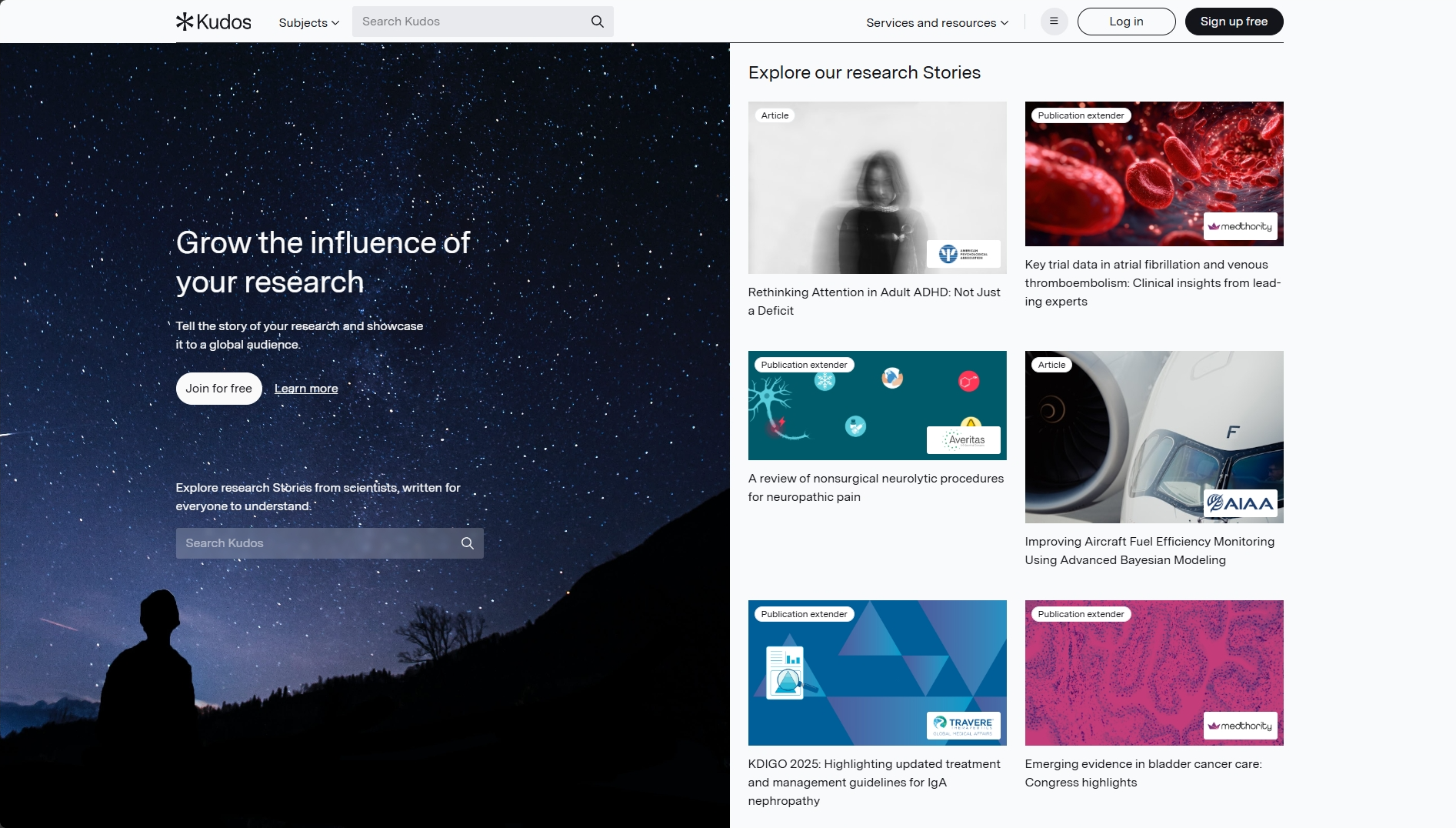
Kudos, a platform that helps researchers share their published work, is being out-cited in LLM training data by an unrelated US fintech also called Kudos that raised over $10 million from QED Investors and ran mainstream PR from launch. In AI-generated answers, the fintech company now dominates the name. Earned media coverage could help fix this.
Most ResTech companies carry their entire public voice through one person on the conference circuit. Six of the seven workflow platforms audited generated zero Tier 1 business press over 2 years – including across two material acquisitions, ChronosHub to the American Chemical Society and Morressier to Molecular Connections – each of which was a publishable business story. Neither received coverage outside STM trade press.
Every acquisition, scale milestone, and policy adoption is a news peg that the business press is structured to cover, and the window for each one closes. Litmaps acquiring Research Rabbit in May 2025 was a publishable story about two citation-mapping tools consolidating. It didn't get Tier 1 coverage and the moment passed.
I think most ResTech companies tend to treat their visibility problem as a media relations problem.
At the fundamental level, they might optimize their web and marketing text, have a strong pitch deck, do webinars, etc. A step higher, they may make attempts to attract media coverage organically (build it and they will come). If these companies advance to active PR – they try to find journalists, pitch stories, and get coverage.
Fine, but even then…
Media relations do indeed matter, but this is one part of a broader communications infrastructure that most ResTech companies haven't built at all.
Most ResTech companies carry their entire public voice through one founder on the conference circuit. That works until the founder steps back, the company goes through a transition, or a crisis emerges that requires a credible, media-trained spokesperson with an established track record.
Academic ResTech has natural stakeholder communities – librarians, research administrators, journal editors, funding bodies – who influence institutional buying decisions and whose trust is worth more than any press release.
Most ResTech companies engage these communities reactively, through conference panels and association memberships, rather than through deliberate, ongoing communications programs that build institutional relationships and surface the firm's expertise in relevant policy and procurement conversations.
This is where the most obvious opportunities are being missed. Six of the seven workflow platforms in my research generated zero/no Tier 1 business press over 2 years, including across two material acquisitions that were each publishable stories, as mentioned above.
The earned media – getting into Bloomberg, TechCrunch, Wired, etc. – matters bigtime, and it's still where AI citation authority gets built. But earned media follows from having named, media-trained executives, an established stakeholder presence, a clear crisis communications posture, and a communications team that treats every acquisition, funding round, and scale milestone as a deadline rather than an announcement.
Are you a ResTech founder, marketing director, or business development manager? Perhaps you’re an academic publisher developing a new service, or a tech firm developing services for publishers. Until now, your PR options have been limited to in-house and to firms only working in academia and the main native-English-speaking markets.
Gareth and I, together with Ellerton’s PR expertise across Southeast Asia, India, China, Japan (my base), the Middle East, and Europe – with specialist partners extending that reach further – have joined part of a team that delivers PR and earned media services built specifically for academic research technology for your company to attract customers and investors, spread the word about your advances and executives, do damage control, build your organic content, and make your business sustainable over the long term.
Get in touch with Ellerton & Co. to explore your research technology’s public relations success.
—
Dr. Adam Goulston is Ellerton’s Strategic Advisor for Japan and the owner of MacroLingo, an Osaka, Japan-based global science and business marketing consultancy. (LinkedIn)
Dr. Gareth Dyke is Ellerton’s Strategic Advisor for scholarly publishing and research. He is a prolific academic author, having published 300+ peer-reviewed articles in leading journals. (LinkedIn)
Stay ahead with analysis and communications insights from teams working across SEA, India, and Europe.
Stay informed with Ellerton & Co.’s latest updates and expert insights at the intersection of PR and business.